
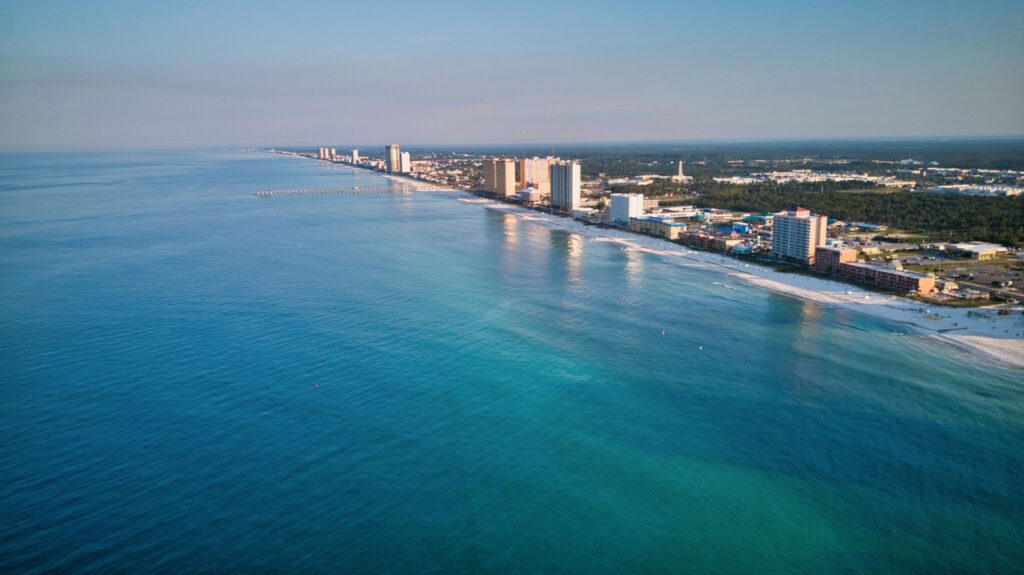
Self-managing a rental in Panama City Beach means handling city paperwork, taxes, and guest communication yourself. You handle the license and tax filings, a local person handles physical visits and cleaning and repairs, and BnBGenius answers guest messages on Airbnb and Vrbo 24/7. Here is what the city expects and how the work splits up.
Registration comes first.
“Per PCB Ordinance 1632 (PDF) , all vacation rentals must have a valid Vacation Rental Certificate. It is unlawful to rent or allow occupancy without one. Note: This applies only to Panama City Beach city limits.”
Source: City of Panama City Beach
What this means for you: You need a certificate first. It covers renting your unit to vacation guests. The rule applies only inside city limits.

What BnBGenius Does for a Host in Panama City Beach
BnBGenius answers guest messages on Airbnb and Vrbo 24/7. For more detail, see Airbnb automated messages and Vrbo automated messages.
Reviews
BnBGenius requests a review from the guest and publishes the host’s review. Kent Morgan put it this way:
“We went from reviewing 40% of stays to 100% overnight. The AI even thanked guests for things we fixed mid-stay. Our review-to-review rate jumped immediately.”
Kent Morgan, BnBGenius co-founder, on bnbgenius.ai/reviews
Cleaning and Repair Tasks
BnBGenius creates cleaning and repair tasks after checkout. Kent Morgan saw the change in his own rentals:
“We used to find out about issues in post-stay reviews. Now BnBGenius flags them mid-stay, creates the task, and our cleaners respond in under 15 minutes.”
Kent Morgan, BnBGenius co-founder, on bnbgenius.ai/tasks
Guest Calls
BnBGenius answers guest calls with a voice AI agent (Voice Concierge, an add-on). Kent Morgan tracked the results:
“The concierge answered 84% of our after-hours calls last month without waking anyone up. Guests thought it was our in-house team the whole time.”
Kent Morgan, BnBGenius co-founder, on bnbgenius.ai/voice
Gap Nights, Early Check-In, Late Checkout
BnBGenius sells gap nights, early check-in and late checkout. Kent Morgan measured the first month:
“BnBGenius filled nine gap nights in the first month. $2.3k we would have lost. Guests got a friendly Airbnb message and we didn’t lift a finger.”
Kent Morgan, BnBGenius co-founder, on bnbgenius.ai/upsells
See the upsells guide for how these offers work.
Running It from Telegram
BnBGenius is run from Telegram. The Telegram page explains the setup.
BnBGenius is not a PMS, channel manager, calendar sync, direct-booking, pricing or accounting tool. It does not prepare city documents, check safety or occupancy, handle your taxes, or act as the city’s responsible party. For tax record-keeping, see the Airbnb accounting and tax software guide.

Your Local Person
The phone duty comes first.
“Be available by landline or mobile telephone at the listed phone number twenty-four (24) hours a day, seven (7) days a week and be capable of handling any issues arising from the rental use;”
Source: Panama City Beach Code
What this means for you: Your responsible party must be reachable by phone at the listed number at all hours, every day. They must be able to handle issues that come up from the rental.
The one-hour rule applies when needed.
“If necessary, be willing and able to come to the rental unit within one (1) hour following notification from an occupant, the owner, or the City to address issues related to the rental; and be authorized to receive service of any legal notice on behalf of the owner for violations of this section;”
Source: Panama City Beach Code
What this means for you: If needed, your person must come to the unit within 1 hour. The visit follows a notification from a guest, you, or the city. They must also be authorized to receive legal notices for you.
Weekly monitoring is required too.
“To otherwise monitor the rental unit at least once weekly to assure continued compliance with the requirements of this Article, including parking and trash requirements;”
Source: Panama City Beach Code
What this means for you: Your responsible party must check the rental at least once a week. The check covers parking and trash compliance. A weekly cleaner is not automatically your responsible party.
Only one party at a time.
“A property owner may change his or her designation of a responsible party; however, there shall only be one (1) responsible party for each Vacation Rental at any given time. If the responsible party is an individual, he or she is required to arrange for an alternate during times of unavailability. To change the designated responsible party, the property owner shall notify the City in writing via a completed form provided by the City;”
Source: Panama City Beach Code
What this means for you: Each rental has one responsible party only. If that party is a person, arrange a backup. The backup covers any time they are unavailable. To change parties, notify the city in writing. Use the city’s completed form.
What the City Requires
Renewal comes around every year.
“Returning applicants must re-register at Panama City Beach STR Portal and be reinspected annually.”
Source: City of Panama City Beach
What this means for you: You re-register each year through the city’s portal. The city inspects the unit again annually. Set a reminder before the deadline.
The renewal deadline is fixed.
“Thereafter, complete renewal applications are due by October 1 of each year.”
Source: Panama City Beach Code
What this means for you: Complete renewals are due by October 1 each year. Today is October 3, 2026, so this year’s deadline has passed. If you missed it, start now.
Renewal requires four documents.
“Follow prompts and upload the 4 required documents A notarized Vacation Rental Registration Affidavit form Proof of DBPR (Department of Business & Professional Regulations) License Proof of Registration with the Bay County TDC / TDT (Tourist Development Tax) Proof of a valid BTR PCB Local BTR (Business Tax Receipt) number”
Source: City of Panama City Beach
What this means for you: For a renewal, upload four things. First, a notarized affidavit. Second, proof of your state DBPR license. Third, proof of Bay County tourist tax registration. Fourth, proof of a valid city Business Tax Receipt.
| Situation | Fee |
|---|---|
| New registration | “$250 Registration Fee 1 $75 Re-Inspect Fee 2 $100 Lock-out Fee 3 Please note, the City of PCB no longer accepts American Express or Discover . New ownership requires a new registration fee. Failed Inspections require a $75 re-inspection fee. Failure to admit the inspector entry or failure to provide means of entry, will result in a $100 “no-show” or “lock-out” fee.” (Source: City of Panama City Beach) |
| Renewal | “After registration is complete, our office will review your submission and send a separate invoice of $75.00 for the inspection. Re-registration Fees $150 Re-registration Fee $75 Reinspect Fee (if required)” (Source: City of Panama City Beach) |
| Late renewal, 91+ days | “91+ days $100 + $250 Renewal eligibility is lost. The property must submit a brand-new application at the full $250 registration fee, plus the $100 late fee – $350 total.” (Source: City of Panama City Beach) |
What this means for you: A change of ownership counts as a new registration. A failed inspection triggers a re-inspection fee. Blocking the inspector triggers a lock-out fee. The renewal fee and the annual inspection invoice are separate. A re-inspection fee applies only if required. If a renewal runs 91 or more days late, you lose renewal eligibility and must start fresh, with a late fee added.
Inspections of occupied units need a person present.
“Occupied units require an escort. We cannot enter without an escort. If you are not present, a $100 lock-out fee will apply.”
Source: City of Panama City Beach
What this means for you: If guests are in the unit, someone must escort the inspector inside. Without an escort, the city charges a lock-out fee.
Violations get a correction window.
“If an inspection documents any violations, all violations must be corrected, and the property re-inspected within thirty (30) calendar days.”
Source: Panama City Beach Code
What this means for you: If an inspection finds violations, you must correct all of them. The property must be re-inspected within 30 calendar days.
Occupancy is set by square footage, not bedrooms.
“The maximum occupancy of the unit as listed on the Vacation Rental Certificate which shall be set pursuant to Chapter 509, Florida Statutes, the Florida Administrative Code, and the NFPA 101 Life Safety Code as follows: i. For one- and two-family dwellings licensed as public lodging establishments: One hundred fifty (150) square feet gross floor area per person. ii. All other Vacation Rentals: Two hundred (200) square feet gross floor area per person. The maximum occupancy for all other Vacation Rentals may be increased to one hundred fifty (150) square feet per person if the City Fire Inspector determines that the Vacation Rental otherwise meet the egress and travel requirements of the NFPA 101 Life Safety Code and is otherwise in full compliance with this Chapter. iii. Maximum occupancy calculations shall be rounded up to the nearest whole person.”
Source: Panama City Beach Code
What this means for you: The inspector sets your occupancy by floor area. One- and two-family dwellings licensed as public lodging establishments get 150 square feet per person. Other rentals get 200. The fire inspector can allow 150 for other rentals only if the unit meets NFPA egress and travel rules and full Chapter compliance. Calculations round up to the nearest whole person. The number on your certificate is the cap.
You must post information inside the unit.
“Post the required information (PPTX) near the main entrance or on the refrigerator. Include the following details: Rental unit address Name and phone number of the responsible party Maximum occupancy (provided by PCBFR after passed inspection) Trash pickup days Nearest hospital location (and a reminder to call 911 for emergencies) Beach safety flag information (PDF) and penalties for violations “Leave No Trace” (PDF) requirements A building evacuation map (minimum size: 8.5 inches by 11 inches) A notice about complying with local noise, parking, and occupancy ordinances (violations may result in tickets or citations).”
Source: City of Panama City Beach
What this means for you: Post the required details near the main entrance or on the fridge. Include the unit address and the responsible party’s name and phone. Add the occupancy given after a passed inspection. List trash pickup days. Show the nearest hospital and a 911 reminder. Include beach flag information and penalties. Add Leave No Trace rules. Post an evacuation map at least 8.5 by 11 inches. Add the notice about noise, parking, and occupancy rules.
A sign or decal goes outside.
“For all Vacation Rentals except condominiums and cooperatives, the sign must be prominently placed on the wall or property of the Vacation Rental so that the required content of the sign shall be legible as viewed from the public right-of-way; however, signage shall not be placed in the public right-of-way. Such signs must comply with size regulations set by the City’s Land Development Code. b. For condominiums and cooperatives, a visible sticker or decal must be placed on a door, window or wall to be visible from the exterior of the Vacation Rental unit. c. The aforementioned sign, sticker or decal must indicate the name, and twenty-four (24) hours per day, seven (7) days a week, emergency contact phone number or the locally available responsible party clearly identified as such, and easily distinguishable from any rental related phone number if different and must state the Vacation Rental Certificate Number of the unit.”
Source: Panama City Beach Code
What this means for you: Signs differ by property type. For rentals that are not condos or co-ops, place the sign on the wall or property. It must read from the public right-of-way but not sit in it. Follow Land Development Code sizes. Condos and co-ops use a decal on a door, window, or wall, visible from outside. Both must show the responsible party’s name and 24/7 emergency phone. That phone must be clearly marked and distinct from any booking phone if different. Add the certificate number.
Your certificate number goes in every listing.
“The property owner shall ensure that the Vacation Rental Certificate Number is displayed for each listing that appears on a hosting platform or any other advertisement for the rental.”
Source: Panama City Beach Code
What this means for you: Your certificate number must be on every listing. It must also be on every other advertisement. Add it to Airbnb and Vrbo alike. Keep it current in each place you advertise.
General codes still apply.
“The property owner shall comply with all applicable codes regarding fire, building and safety, health and safety, parking, noise, solid waste, sea turtle nesting season, and other relevant laws, including, but not limited to, all fire safety requirements of state law, including those described in Rule 69A-43, Florida Administrative Code.”
Source: Panama City Beach Code
What this means for you: You must follow all applicable fire, building, safety, health, parking, noise, trash, and sea turtle codes. State fire safety rules apply too.
High Impact Periods add conditional duties.
“When a Vacation Rental property is located within an area and dates that have been designated as a HIP pursuant to Sec. 4-2 of this Code, the property owner and Rental Responsible Party shall implement the following additional precautions for the duration of the HIP:”
Source: Panama City Beach Code
What this means for you: Extra precautions apply only in a designated area. They also apply only on designated dates. Both conditions must be met together. This summary does not list the full HIP rules. Read the linked code section if a designation covers your property.
Taxes
Florida taxes short-term rentals at the state level.
“Florida’s 6% state sales tax, plus any applicable discretionary sales surtax, applies to rental charges or room rates paid for the right to use or occupy living quarters or sleeping or housekeeping accommodations for rental periods of six months or less, often called “transient accommodations” or “transient rentals.””
Source: Florida Department of Revenue
What this means for you: Florida charges 6% sales tax plus any applicable surtax on stays of six months or less.
Bay County’s 2026 surtax rate appears in the state table.
| County | 2026 Discretionary Sales Surtax |
|---|---|
| Bay | “Bay 1% (.5%) Jan 1, 2011 Dec 31, 2030 (.5%) Jan 1, 2017 Dec 31, 2036” (Source: Florida Department of Revenue) |
What this means for you: Bay County’s surtax is 1%, made of two 0.5% parts. One expires December 31, 2030. The other expires December 31, 2036.
The county tourist tax is separate.
“The Tourist Development Tax is a 5% bed tax collected by a special taxing jurisdiction within Bay County on short-term/vacation rentals. The taxing jurisdiction includes all properties from the Phillips Inlet Bridge to the Hathaway Bridge south of Panama City Beach Parkway, as well as all property within the city limits of Panama City Beach, Panama City, and Mexico Beach.”
Source: Bay County Tax Collector
What this means for you: The tourist tax is 5% on short-term rentals. The district covers all of the city limits plus other listed areas. It does not cover the whole county.
Owners must register, collect, and remit.
“All owners or operators of the above listed facilities are subject to the Tourist Development Tax. All owners or operators are required to register the facilities and collect this tax from their tenants or guests. Collected taxes are remitted to the Bay County Tax Collector.”
Source: Bay County Tax Collector
What this means for you: You register your rental with the county. You collect the tourist tax from guests. You send it to the Tax Collector.
The collecting office changed recently.
“Effective October 1, 2026 , the administration and collection of the Bay County Tourist Development Tax has transitioned from the Bay County Clerk’s Office to the Bay County Tax Collector’s Office.”
Source: Bay County Clerk
What this means for you: Since October 1, 2026, the Tax Collector handles the tourist tax. The Clerk no longer administers it. Send filings and payments to the Tax Collector.
The platforms do not remit the local tourist tax.
“The short answer is no. The long answer is that our office holds no agreement of account with any online advertiser, and because of this, Airbnb/VRBO does not and cannot file with our office on your behalf.”
Source: Bay County Tax Collector
What this means for you: This covers the 5% Bay County tourist tax. The county has no agreement with Airbnb or Vrbo. Neither platform files this local tax for you. Handle it yourself.
Platform handling of state taxes differs.
| Platform | Tax handling |
|---|---|
| Airbnb | “Florida Transient Rental Tax: 6% of the listing price including any cleaning fee for reservations 182 nights and shorter.” (Source: Airbnb Help) “Florida Discretionary Sales Surtax: 0.5%-1.5% of the listing price including any cleaning fee for reservations 182 nights and shorter.” (Source: Airbnb Help) “Hosts may need to manually collect and remit other applicable taxes on their stay or experience price.” (Source: Airbnb Help) |
| Vrbo | “Florida State Transient Rentals Tax, Discretionary County Surtax Note: Discretionary County Surtax is state tax surcharges required by various counties that Vrbo will also be collecting and remitting. These rates vary between 0.5-2%. The state of Florida under 184 nights December 1, 2018” (Source: Vrbo Help) “You’re also responsible for collecting and remitting lodging taxes when we’re not liable to do so.” (Source: Vrbo Help) |
What this means for you: Airbnb collects Florida’s 6% transient rental tax plus a discretionary surtax listed at 0.5%–1.5% statewide, for reservations of 182 nights and shorter. That range is not Bay’s 1% rate. Airbnb says hosts may owe other taxes manually. Vrbo collects and remits state transient rental tax and county surtax, listed at 0.5%–2%, for stays under 184 nights. Vrbo says you handle taxes where it is not liable. Neither page shows a Bay tourist tax row. The scopes differ, so do not add the percentages. BnBGenius is not an accounting tool.
Airbnb and Vrbo
Both platforms run reviews differently, and the windows matter.
| Platform | Review window |
|---|---|
| Airbnb | “On the day of checkout, both the guest and their host will be prompted to leave a review . Both parties will have 14 days after checkout to submit their review.” (Source: Airbnb Help) |
| Vrbo | “You and your guests have 180 days to provide your review. Once one party submits their review, the other party has 14 days to complete their review.” (Source: Vrbo Help) |
What this means for you: On Airbnb, you and the guest each get 14 days after checkout to submit a review. On Vrbo, you both have 180 days. Once one party submits there, the other has 14 days.
How to Start
See pricing for plan details.
More City Guides
- Airbnb rules in Destin, FL
- Self-managing an Airbnb in Gulf Shores, AL
- Airbnb rules in Tarpon Springs, FL
- Airbnb rules in Dunedin, FL
- Florida short-term rental laws by city
Rules and rates last checked on 3 October 2026.